Truss Rod Adjustment
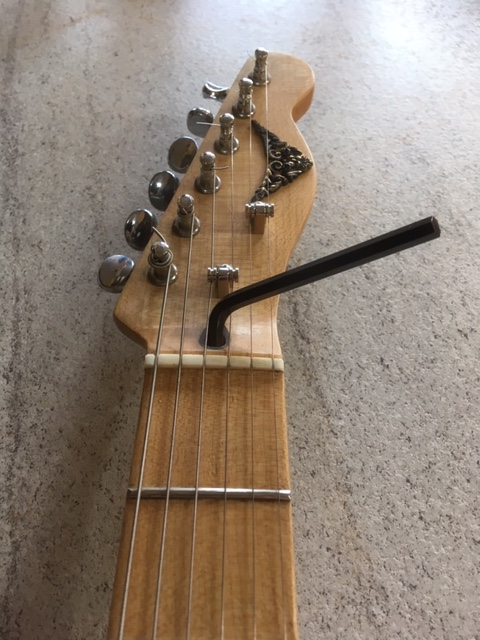
The truss rod is a device fitted to most modern guitars to control the BOW of the neck, as the strings are tension-ed to tune the guitar the neck bows, but not always in the way people imagine, it actually forms a gentle S shape, a certain amount of bowing of the neck allows the strings to oscillate, too flat and you will have buzzes, its fair to say that setting up the truss rod is as much an art as a science, this is because of the variables, for example, String gauge, thicker strings will affect the tension on the neck, different woods, some will bow more than others, this can depend on the age of the neck and the orientation of the grain, flat sawn tends to give a bit more than quarter saw, then you have the fretboard playing a part, and so the variables go on, its much easier to say that all necks are a bit different.
the Relief in the neck can be measured by placing a capo on the first fret and then holding down the string on the last fret and then measuring the gap between the 7th fret and the string with a feeler gauge somewhere between 8 and 16 thousandths of an inch is the ball park you want to be in, a bit flatter will give you a lower action, as a general rule turn to the right to tighten and left to loosen.
Left = More relief, more bow.
Right = Less relief, flatter lower action.
I must just add the caveat that some, (very few) can be the polar opposite, this is because on a dual action truss rod if you install it upside down everything is reversed, I know of one luthier who does this on his hand crafted basses.
Bridge adjustment


String height is governed by the neck radius above you can see the tools used to check the radius of the neck and the strings, once the radius of the neck is established you need to ensure that the strings follow that curve, above you can see the use of the neck and string radius guides.
Below is the string height being measured at 1mm at the 12th fret this is quite low for a telecaster, but this one is set up for speed.

in order to achieve a low action you will need to have the neck quite flat and the frets all level, below you can see a fret leveling device which avoids the need for tension jigs, as it levels whilst the strings are on, and is accurate to 1 thousandth of an inch per foot.
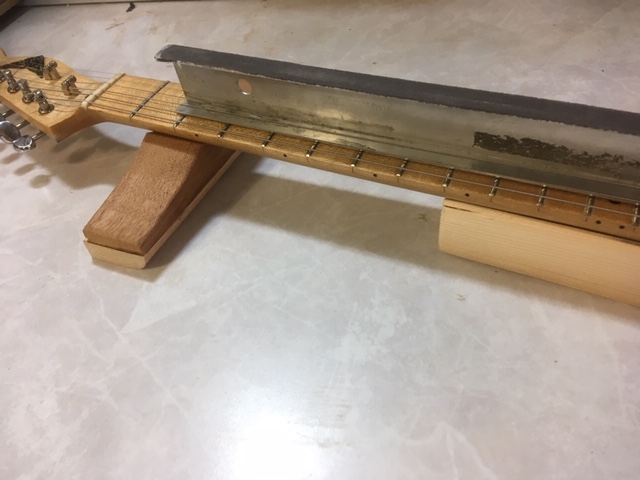
after fret leveling, the frets need to be dressed.
Heres a link to Dan Erlewine’s You-Tube site, Dan is one of my go to guitar build heroes, hes been building guitars since the 60’s, and hand built “Lucy” Albert kings flying V guitar which Albert played until his death in 1992,
in this video he shows how to find a high fret, using a fret rocker.
If you keep watching on to the second video Dan goes backstage at the Joe Bonamassa Three Kings tour and is reunited with “Lucy” there’s a short interview with Joe and his Guitar Tech on his set up for guitars and amps how they string his guitars for the tour.
 Lucerne Guitars