Baked Maple Neck (Torrefied Maple)
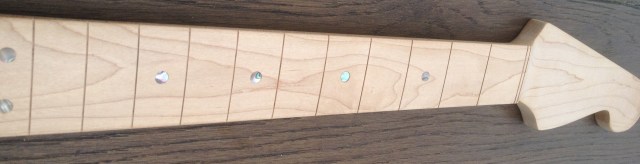
This is a strat neck I made from a piece of baked maple there has been much debate over the process and its application to guitars.
Torrefaction is not a new process. In the 8th century the Vikings torrefied the wood they used to build their ships, enhancing its stability and durability. Scandinavian countries have been improving this age-old procedure since the 1930s.
The wood is gradually pre-heated in a conventional kiln lowering the moisture content to between 6% and 10%. After that the wood is heated at a very high temperature (between 190C to 240C), in a torrefaction kiln (autoclave) under pressure and in a low oxygen atmosphere (to prevent combustion), lowering the moisture content to almost 0%. The length of the process, as well as the temperature degree sustained, depends on the species and the desired color of the wood. Finally, the wood is placed in a conditioning chamber where the temperature is gradually lowered by controlled steam injection and the moisture level of the product is increased to between 3% and 6%, giving back the wood’s natural flexibility.

I had this piece baked in an electric Pizza oven over a period of a week i asked the chef to place it in the oven every night for a week and loosely wrapped it in silver foil, after he had finished baking pizza, the oven takes hours to cool from 300 degrees Celsius, as you can see the wood has darkened and is almost burnt on one end.
Some luthiers have had reported problems gluing and bending this wood, but being as this is a strat neck i souldnt be experiencing this, although I do have to fit a skunk stripe.
Once planed and shaped the wood retains much of its original color and is only a few shades darker. it planes, saws, and sands like mahogany, it feels a bit lighter (I still have 2 lengths from the same piece of wood)
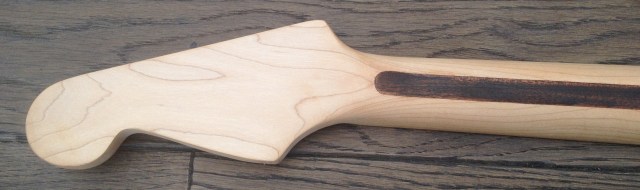
Ive fitted the skunk stripe its a T shape and glued it in with Tightbond 2, (no issues to report)
Neck Scalloping
Ritchie Blackmore was the first musician that I became aware of that had used scalloping on a neck, but apparently the earliest recorded scalloped finger board is in a museum in Salzburg (Austria) and dates back to the second half of the 19th century.
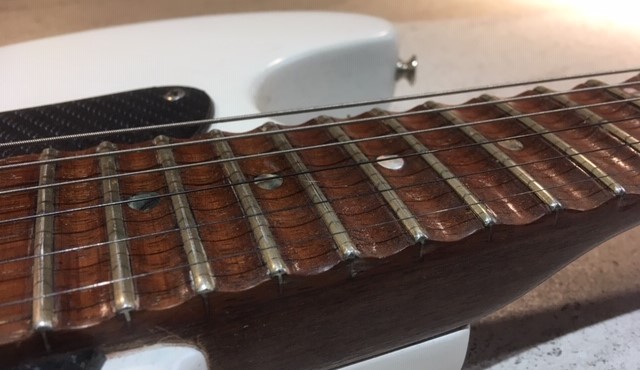
I scalloped this old cheapy just to see how hard it was to do, Luthiers charge quite a lot to do this and with good reason, the risk of permanent damage to the fingerboard is high and great care has to be taken, even though great care was taken and all the scalloping done by hand, this one had to be re fretted and have new fret markers installed, I replaced the old plastic with Abalone.
Yngwie Malmsteen, has set a trend for the widdlers amongst you, and you may be tempted by the fast playing associated with the scalloped fingerboard, but think long and hard about it before you start grinding at your favorite guitar neck, its an irreversible mod and is a love hate thing, I hate it, people have asked me to scallop necks and i have lent them this one for a week and they have all, decided against. initially it is great and you can play differently but its not long before you miss the wood under your fingers, and the feel of your old guitar.
 Lucerne Guitars